Maureen talks about her time with the mobile library service. She started as a library assistant and later became the Mobile Library and Delivery Service manager. She retired in 2015 after 30 years in the Service.
Addenbrookes Hospital
I wanted to work in a hospital, having spent quite a lot of time in one as a child. The organisation and its way of life appealed to me. My father-in-law was a porter at the old Addenbrookes Hospital on Trumpington Street, Cambridge. He got me a job as a courier. That job took me to every nook and cranny of the building. I got to know all the people too, from all walks of life. The staff nurses were quite scary. They ran a tight ship on the wards. But it was lovely there.
After about a year, the librarian of the hospital library told me about a position for a library assistant in the Cambridge University Medical Library. This library was specifically for medical professionals, so there were a lot of medical books and monthly periodicals to look after. I did that for a few years. It was extremely interesting.
After a period of time, we moved to the new Addenbrookes Hospital on Hills Road, Cambridge. It was a massive organisation, unlike the old hospital, so it was very different. You didn’t get to know as many people. It was also a medical training school.
Moving to Norwich
My husband and I had come to Norwich on our honeymoon. We fell in love with it, and in 1975 we moved there. My husband felt he wanted a change and I was quite happy to move. We opened a women’s fashion business with another couple. The other wife and I used to go up to London to buy the stock. We’d carry it back on the train in black plastic bags. It was great fun. We did this for two or three years.
Joining the Mobile Library Service
I was a stay-at-home mum for the first few years after my daughter was born, which I enjoyed. But then she started school and I thought ‘I need a purpose in life. I need some sort of career.’ I happened to open the evening paper one day and saw an advertisement that sparked my interest. It was for a part-time library assistant on the mobile libraries. It was something I had experience in to a degree, and something I wanted to do. But the deadline was in 24 hours. It was rather manic. I filled out the paperwork, told my husband about it, and said ‘I’m just going to pop this in the post.’
Thankfully, the application arrived in time and I was offered an interview. It was quite an enjoyable interview. But one of the questions I was asked was ‘oh, you have a child. What will you do if your child falls ill on the day you need to come to work?’ You’d never be asked something like that today. Fortunately, my husband was self-employed and I had in-laws who lived close by, so I was able to answer.
I was offered a six month temporary contract and I took it. Little did I know that six month contract would turn into a 30 year career.
Mobile Library Assistant
In the past qualified librarians had been going out in the mobile libraries with a Heavy Goods Driver (HGV) assistant. The qualified librarians were now being offered positions in public libraries. The mobile libraries would be filled by people like myself, who had some sort of library experience. We were called library assistants.
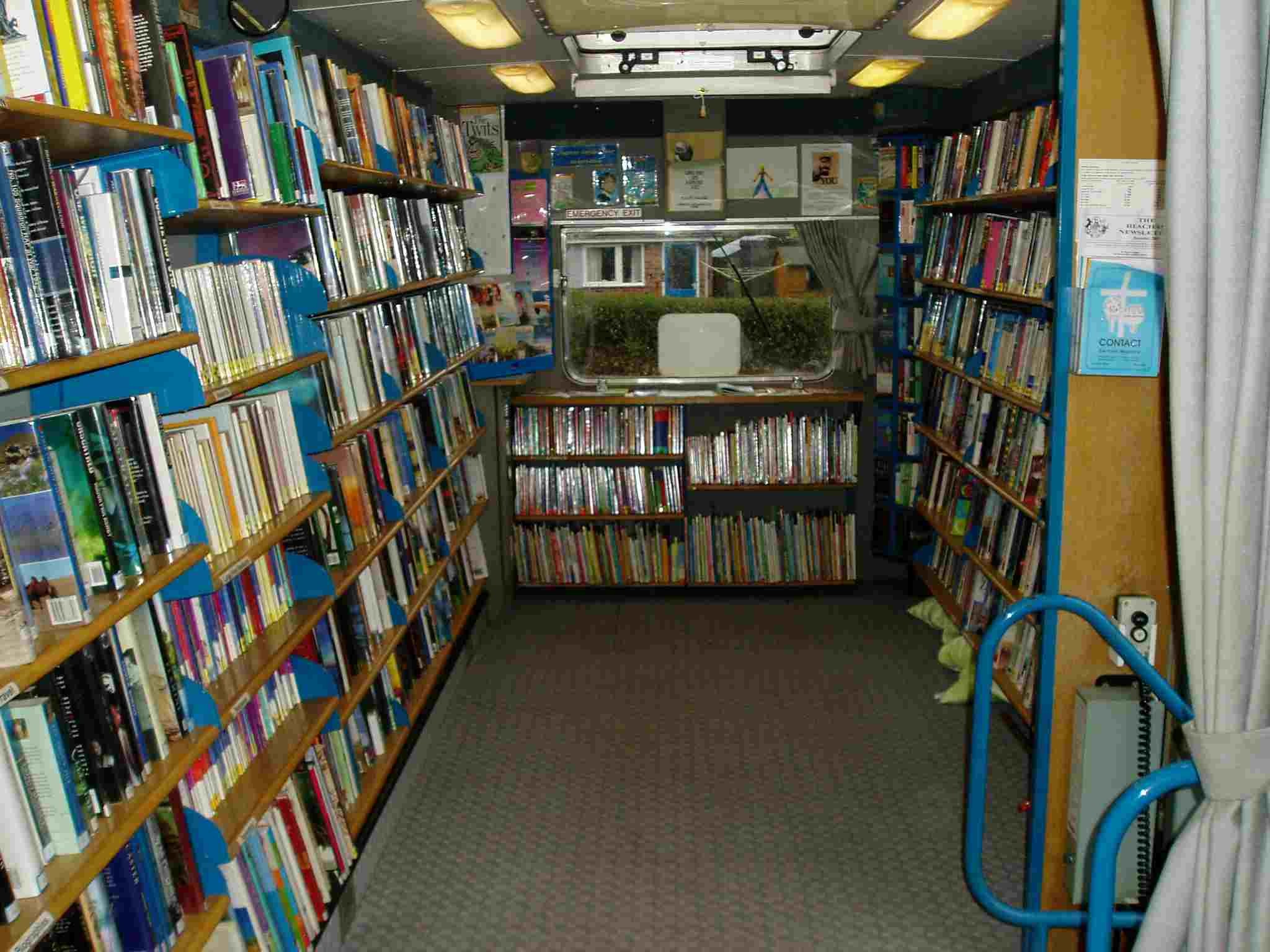
We had seven mobile libraries at the County Hall at the time. There were others at Dereham, Downham, Dersingham, Wells, and North Walsham. You had a different driver each time you went out. You never knew which van you’d be going out on in the morning, but it didn’t really matter. It was all pretty basic. There were no facilities, no hot water, no kettles. The heating was run on Calor gas, and we had to call into the Norwich Cattle Market on our way out to make sure the tank was full. If it was a wintry day; your demister for the windscreen was a piece of sponge on a long stick.
There were no toilets. This was a bit of an issue. Customers were willing to offer use of theirs, but on some village stops there was nothing open or available. You’d have to find a nice discreet bush. Once, in Seething, I thought I’d found a nice little run of hedgerow that was discreet. I’d forgotten it was in Seething, which had an airport that gliders were flying out of all day. Gliders make no noise. When I looked up as I was walking back to the van, there was a glider hovering above me. I just waved at it. It was quite an embarrassing moment.
The stops
We went to nurseries. We had stops in playgrounds where the children and the mums would get on the van. We used to go to small estates, travellers’ sites, and village halls. A lot of the stops were isolated locations. We went to the Carmelite Monastery in Quidenham, where Sister Wendy resided. If you’re not aware, Sister Wendy was the famous art historian. She was a wonderful woman who loved her crime novels. We used to joke about what she might be plotting.
If you were on an unfamiliar route, you could easily tell where the stop was. There would be a huddle of people standing by the road with bags of books. They’d be waving you down. It always amazed me that people would be there on the dot waiting for us. It made you feel as though you were providing a really good service to the community.
Issue system
Each customer was given a little brown pocket, as we used to call it. On that pocket would be the customer’s name and address. Each book had a card inside with its title, author, and other publication information. When customers brought the books to the counter, the card would be removed from the book and put inside the customer’s brown pocket. There was no limit on the number of books you could borrow. Sometimes those pockets were bulging with elastic bands around them. We were issuing between 600 and 800 books a day. It was like playing sardines on the mobile library at times, particularly at the first stop on the morning. It was good fun.
The brown card system was eventually replaced by a simpler process. The customers each had their own card with their name and information on it. When they came to the counter, we would simply count the items and write that number on their card. Consequently, we didn’t know what books they’d borrowed. Sometimes they’d come on the van and say ‘oh, I feel sure I’ve got another book at home.’ You’d look and say ‘well, yes, you’ve only returned five, but you took out six.’ But you wouldn’t be able to tell them what that book was.
The customers
You met all sorts of people, and some amazing characters. You’d even meet the landed gentry. It was a social event. Some of the people who came had not spoken to anyone since the last time the mobile library came through.
I remember we had a couple of ladies (I think they were sisters) who lived in a farmhouse and kept goats. We always had to make sure we had a can of air freshener under the counter for when they came. In one village, there was a lady who would bring her wheelbarrow. Her family were avid readers, herself included. She’d get non-fiction books for her husband and novels for herself, and she’d leave with a wheelbarrow piled high with books.
I remember one teenage girl who was really into Virginia Andrews stories when they were first published. I used to do my best to try and get her the follow-on title, and she was thrilled to bits with it all. She used to tell me how she wanted to become a doctor. She was aiming to that all through her school life. About 15 years later I had to go to hospital for a medical procedure. I encountered her there. She said ‘thank you very much for everything you did. I didn’t quite make it as a doctor, but I am a trained radiographer.’ I was very impressed.
I saw a lot of children working their way through school. They’d tell me what their next school project would be, and we’d find the books to help them on their studies. It was a real treat to see them grow up. Years later they’d come onto the van with their own children, passing on the love of reading.
Incidents
There were many incidents that happened on the vans. When we got back to County Hall at night, we’d all relate stories about what happened during the day.
One of the funnier incidents happened to a colleague of mine. One of their readers was up on his roof waving at them. She waved merrily back and they went through the village, doing a few stops. They had to go back through the village on the way out and the gentleman was still on his roof. They waved at each other again. It wasn’t until they went on the route a fortnight later that they learnt it was a distress wave. He’d been stranded on his roof.
I had a most unfortunate situation one day. A gentleman walking up to the vehicle fell and sustained quite a serious head injury. My instinct was to dash off the van and help him, which I duly did. A retired nurse was standing in her lounge window at that time. She witnessed the incident, and reached the man before I did. I have never been so pleased to see a nurse in my life. She took charge, and obviously an ambulance was called. I couldn’t quite decide what to do, but I knew where he lived with his wife, so I went to tell her and bring her to the ambulance. The injury was so serious that the gentleman did die, so it had a sad ending.
Another incident was a lady slipping on the icy pavements. She broke her hip, so we had to stay and support her until the ambulance arrived. We were late to the rest of the stops. People were calling into the office and saying ‘where’s the mobile library? It hasn’t turned up today.’ We did our best to inform the office what the situation was, but there were no mobiles at the time. We had to use people’s telephones.
My daughter was about seven or eight, and a keen sports girl. During one PE session at school, she dislocated her knee. The school didn’t quite know what to do. They knew I worked on the mobile libraries, so they rang County Hall and spoke to the office. The mobile library office consulted the schedule to see where I was. I was outside Mulbarton School, so they rang them. The headmistress came rushing out. ‘Oh, Maureen’ she said. ‘You must get into my car. I’ve got to take you to hospital. Your daughters had an accident.’ They’d tracked me down and got the message to me.
Working with other organisations.
In my time working for the mobile library service, I worked alongside different organisations. We used to supply deposits of books to some hospitals, which were delivered via the St John’s Ambulance Service. We worked closely with them. The police would sometimes send out new recruits on a mobile library for a week. It was to give them experience in countryside life and the needs of rural people.
Reviews of the Service
We went through a couple of reviews of the mobile library service. One particular review we had to fight quite hard to justify our worth, but we had phenomenal customer support for that. They were writing in letters saying how valuable a service we were. In the end we won. That would have been around late 1990s, early 2000s.
Job share Library Manager
I spent 11 years travelling on the mobile libraries. And then I took up a job share of being the library manager. The colleague I shared the job with was a very lovely lady. We worked well together despite having quite different ways of working. I was a bit OCD and liked all my papers symmetrical on the desk. She would have to shuffle through piles of paper to find what she wanted, but she always knew where it was. We got on well. Unfortunately, she had to retire around 2004, when the new senior management came in.
Full-time Mobile Library and Delivery Service Manager
After my colleague retired, I was appointed the full-time mobile library and delivery service manager. It was another office job. I wasn’t going out on the vans anymore. I did miss going round the countryside and meeting the customers. If there was ever a rare opportunity to go out on the vans, I’d grab it.
I did have to do appraisals of the vans. My job also involved supporting the area mobiles as well. Each area mobile had their own library manager responsible for them, but they’d liaise with me if they needed to.
A changing service
In 2004, a new senior manager was appointed. With him came a bit more financial investment. This was when mobile libraries really started to progress. It was a bit daunting, but it was welcomed because we didn’t feel like we were recognised in the way branch libraries were.
There were quite a few changes at this time, which were largely to reflect the usage and increase efficiency. We had to monitor how many books were issued per minute. This would determine whether a route was to be double staffed (a driver assistant and a library assistant) or single staffed (the driver assistant manning the service on their own). Some routes with parishes that had more than a thousand residents were switched to a fortnightly service instead of a monthly one.
The new manager wanted to improve the service. He was keen and motivated. One of his first achievements was to introduce a computer system on the mobile libraries. The first computer system was offline, which meant that the information on it had to be downloaded at the end of the day. All the customers had a library card. These cards could be used in branch libraries as well.
We operated with the offline system for about two to three years. Eventually, with the help of the computing department at County Hall, we found ways of introducing a fully online computer system. We felt as though we’d arrived at long last. It was wonderful and changed the whole service. If customers didn’t know what books they had at home, staff could access their accounts and tell them which items they had on loan that hadn’t been returned. Staff could also request to have books transferred from branch libraries.
This change wasn’t welcomed by all the staff. Some more mature members of staff were a little afraid of the computers. With lots of training and support they came round to the idea.
Improved vehicles
Another thing the new senior manager wanted to improve was the vans themselves. Once we had approval to purchase a new vehicle, the manager and I would go to the manufacturers to see its progress. It was a very male orientated environment, and at times I felt a little uneasy.
We had considerable input into how the vehicles were arranged. I knew nothing about the mechanical side of it, but I knew a lot about working in the mobile library, so it was good to have influence on that.
The new vans were a vast improvement in looking after the staff and the customers. We were able to add running hot water and a kettle. We had a safety gate installed. A simple thing, but it was necessary for when we delivered services to nurseries. The teachers would bring the children onto the van and they’d sit and choose their own books. There’d be toddlers who’d run around the vehicle, making a safety gate necessary.
One of the major improvements was the introduction of toilets on the vehicle for staff. It was one of our driver assistants who came up with the plan for it. He designed the rear of the vehicle with a toilet accessible from the outside of the vehicle. It was duly taken onboard by the manufacturers, and he had a lot of input on it. He received an achievement award of some sort at one of our annual national meetings. The staff were truly grateful to have a toilet and sink.
Training organisation
Driver assistants had to have a lot of skills. They had to have a HGV licence, they had to be able to communicate with the general public, and they had to have a certain amount of library knowledge. It was challenging for quite a lot of people. In 2011, it became law that the driver assistants had to obtain a Certificate of Professional Competence (CPC). This required them to attend 35 hours of relevant training. With around 25 drivers to train, including the relief drivers, it was going to be a massive expense for the County Council.
My boss at the time made the decision to set up our own training centre. Myself, our senior manager, and our lead driver had to study to achieve the Preparing to Teach in the Lifelong Learning Sector (PTLLS) qualification. It was above and beyond our daily duties, but we all achieved it. I was quite proud of it.
With the PTLLS qualification we were able to set up our own training organisation. This had to be approved by the Joint Approvals Unit for Period Training (JAUPT), which was very strict. There was a massive amount of work to do for this. The lead driver and I had to put together our own training materials. Fortunately, he was well-versed in the laws and regulations around HGV driving. Between us we managed to put together a number of different training courses. We then had to give our staff those 35 hours of training to get the CPC qualification. The accredited organisation would sometimes come to observe us to make sure we were doing things correctly, so it was a very serious situation.
We achieved it. Not only that, but for a period of time we offered our training service to other organisations. We ended up saving the County Council a lot of money because it would have been extremely expensive to send the drivers elsewhere for this training. We were awarded an Outstanding Contribution Achievement Award (OSCAR) by the County Council. There was an evening of celebrations at the Castle. We were all very proud.
Long may it continue
I’ve been retired for ten years now, but the mobile library is still very close to my heart. All I can say is long may it continue.
Maureen Cornell (b. 11952) talking to WISEArchive in Norwich on 21st November 2025. © 2025 WISEArchive. All Rights Reserved.