Paul has been a tour guide in Norwich for 11 years. He talks about aspects of King Street’s history, including Julian of Norwich, the Music House, and Dragon Hall.
A fulfilled ambition
I was born in the north-east, so I’m a Geordie. In 1988, I moved to Blickling for my job with the National Trust. I was a regional marketing and communications manager. I did that for ten years in Blickling. Then I went freelance to do PR work for tourism businesses in Norfolk.
I fulfilled an ambition of mine 11 years ago by training as a tour guide in Norwich. It was a year long course with lots of lectures about the history of the city, how to take people out on tours, and about special subjects like architecture. It also covered the Norfolk Broads. We were taught a tour called the City of Centuries. Since then, I’ve been doing lots and lots of tours. I have a whole package I offer; it’s got up to 21 now so there’s plenty of tours people can go on in Norwich. I also have three tours in the Broads and two in Cromer.
Julian of Norwich
One of the tours I do is Julian’s Medieval Norwich, so I’m going to talk a bit about the significance of Julian to the King Street area and to Norwich as a whole. Julian is a very important figure because she was the first woman to write a book in English. We don’t really know much about her. We don’t know her name. St Julian was an early Christian bishop in France and St Julian’s church was named after him. Julian of Norwich was named after the church.
Julian was born around 1343. She survived the Black Death as a child. At the age of 30 we know she fell seriously ill. She thought she was on her deathbed. The priest was about to give her the last rites. As he held the crucifix up in front of her, the crucifix transformed into a vision of Jesus on the cross. She had 15 separate visions and recovered. She wrote down these visions – or dictated them to someone – but it’s thought they were written down very quickly.
By the 1390s, Julian had become an anchoress at St Julian’s church. An anchoress or an anchorite is someone who gave up their life to prayer and shut themselves away from society. As an anchoress you were literally walled into your cell, which was attached to the church. You couldn’t leave. Upon your death your body was buried underneath the floor of your cell. Julian would have had a little squint so she could see into the church to watch the mass. She would have had a window to the outside that was covered over, which allowed people to come and consult with her. She had another window through to where her maid was.
It was a tough life as you can imagine, and the servant played an important role. They supplied the bodily needs, so in comes the food and out goes the rubbish. So to be an anchoress you needed a servant and you also needed money. This is one of the things that make people think Julian may have come from a wealthy background. We do know that four people left money to her in their wills, and there could have been others. Another will left money to her servant, which is quite interesting as well.
Julian was an anchoress for more than 25 years. That’s a long, long time. People in Norwich would have come to ask her advice and consult her. She would have had lots of conversations with people. It would have been incredible to come and talk something through with Julian of Norwich.
Revelations of Divine Love
Whilst Julian was in her cell, she reflected on what she’d been shown in her visions and expanded on them. She thought about the theological implications of what she’d been shown. She must have dictated it to someone at some stage, who wrote it down for her. The initial download of her visions is called the short text, and her theological reflection combined with the visions is called the long text. It’s all in English, the first book written by a woman in English. It’s pretty dangerous to write about theology in English during the late 14th century because it’s all controlled by men who all know and write in Latin. Writing in English puts you in danger of being called a heretic. I think the fact Julian was on her own in her cell helped protect her from outside invasion into what she was doing. She obviously had people who looked out for her.
The long text is first published in France in 1670. How it got to France we have no idea. It is then published in England for the first time in the mid-19th century. In about 1910, the short text emerged in a box of religious texts the British Museum bought. They had no idea it was in there. In the 20th century the short text and long text are combined into the one book. The book today is called Revelations of Divine Love.
A view of Julian
In Julian’s writing she doesn’t explain much about herself. The only real view we get of her is from a book by another Norfolk mystic called Margery Kempe. Margery Kempe was 30 years younger than Julian and she came from King’s Lynn. She had all sorts of visions specifically of Jesus and was very much out there as a mystic. She got into a lot of trouble for this, and also because she was a woman. Priests, who were all men, didn’t want women to have any power. She was accused of heresy several times. She always managed to get herself off which was interesting, she had supporters.
Margery was encouraged by a priest she knew to come to Norwich to consult with Julian. To ask Julian for advice on whether her visions were real and if she should continue on her path. She comes to see Julian and gets on very well with her. They spend a number of days together, with Julian in her cell and Margery sitting outside talking through the covered up opening. They became friends, and Julian encouraged Margery to continue. She said she knew her life was difficult but the visions she was having are true and she should continue on her path. I’ve paraphrased that.
Near the end of her life in the 1430s, Margery writes a book about her life. It’s thought her eldest son was her scribe. This book is the first autobiography in English. It’s quite incredible in Norfolk we’ve got the first woman to write a book in English and the first autobiography in English which also happens to be written by a woman. We should be, and are, very proud of it. Through Margery Kempe’s book we get this image of Julian as this wise woman she undoubtedly was.
Norwich in the Middle Ages
Julian wasn’t the only anchoress in Norwich. Between the 13th century and the Reformation there were more than 50 people who took on this extreme life. By contrast there was only a dozen or so in London. Norwich was a very important city, and a very religious city as well. Before the Black Death in 1348-1349 there were more than 60 churches in Norwich. There were four friaries, the Benedictine monastery (now Norwich Cathedral), and the nunnery at Carrow Abbey. There was also a college for training priests where the Assembly House is today. Norwich was a wealthy city as well, which was needed to sustain these anchoresses and anchorites because they needed financial support to live.
King Street in the Middle Ages
King Street was definitely around during the Norman period. It was a very important merchant’s street. It’s also the longest street in Norwich which is amazing when you walk down it, because don’t forget Upper King Street. It was a high class area too, which is why it’s thought Julian might have come from money.
The nunnery at Carrow Abbey had a school for girls. At one stage it was thought that Julian was a nun educated there. That theory has been largely disproved so people no longer believe that. Carrow Abbey had the second largest church in the city after Norwich Cathedral. It was enormous, and had a very small number of nuns.
Next to Dragon Hall, where there’s now a building site, was the site of the Augustinian friary. They arrived in the late 13th century and established a school for the study of philosophy. People came from all over Europe to study philosophy on King Street in the Middle Ages, which I find quite fantastic. Further along King Street you had the Franciscan friary which began on the corner of Rose Lane and went all the way up to Tombland. It was enormous, and was there since the early 13th century. They also had a school for higher study and again people came from all over Europe to study there. It shows how important Norwich was.
Anchorholds and Julian’s cat
Churches that held cells for anchoresses and anchorites were called ancho holds. In the King Street area there were three. There was St Julian’s church, St Ethelreda’s further down King Street, and St Edward’s. St Edward’s is long gone now, but it was across the road on the other side of Rouen Road (which didn’t exist during the medieval period).
Once you’d taken up the vows of an anchoress you weren’t allowed to leave. You were allowed to have a cat, and it wasn’t so you could have a pet to stroke. The cat was there to keep the vermin down, the rats and mice. There are images people have created of Julian with her cat.
The Reformation
When Henry VIII closed down all the monasteries and friaries in the second half of the 1530s, early 1540s, all anchor holds were closed down. Julian’s cell would have been demolished so there was nothing left of it. Any anchoresses and anchorites in Norwich were given a pension and sent off back to the ordinary world. It must have been quite a traumatic thing to do for them.
We know the name of one anchoress in Norwich. She was attached to the Dominican friary, which is nowadays St Andrew’s & Blackfriars Hall. Her name was Katherine Manne. She was an anchoress there for ten years before the anchor holds were closed. She got her pension and off she went, and that’s the last we hear of her.
Julian’s legacy
In the second half of the 19th century interest in Julian of Norwich grows. The first thing that happens is a shrine is attached to an outside wall of St Julian’s church. It’s next to a bit of ancient flint work close to the ground which is thought to possibly be part of Julian’s cell. Of course we don’t know, but it’s a good guess as to where it might have been.
In World War II, St Julian’s church is bombed. St Michael at Thorn, which was just up the road roughly in the car park behind Prospect House, was also bombed, and it was bombed beyond repair. After World War II it was decided to restore St Julian’s church. When St Julian’s was bombed, the tower had literally folded in on the church, causing a lot of damage and destruction. Fortunately, it didn’t hit the altar where there’s a wonderful reredos from the 1930s that has survived. It’s incredible actually that it survived.
The church was rebuilt. The tower is much truncated, it’s not like the original tower. In the church you can see photographs of what it used to look like before the bombing. When they rebuilt the church, they took the opportunity to build a chapel on the possible site of Julian’s cell. That’s the Julian shrine today. The doorway you go through into the chapel is a Norman door from St Michael at Thorn. It had survived the bombing and was brought down the hill.
It’s really interesting the number of visitors that come to St Julian’s church. And of course, in the Julian Centre there’s a great welcome. There’s tea and coffee, there’s loos which is very important, and it’s a book shop and gift shop as well. It’s a lovely space to visit when you come to the church. You can also stay in the All Hallows Guest House, which is next door. People come from all over the world to visit here inspired by Julian of Norwich. It’s a pilgrimage to visit the site of Julian’s cell. On my guided tour, Julian’s Medieval Norwich, I’ve taken a number of people who’ve come to Norwich specifically to understand more about Julian. They enjoy learning more about the medieval city as well, which I cover on the tour.
Dragon Hall
Robert Toppes was a very important Norwich merchant in the first half of the 15th century, so he was almost a contemporary of Julian’s. He was the first man to build a stand-alone showroom warehouse. Normally merchants lived on top of the office, but this was an office that he had to come to work to, which I find fascinating. It was the first in Europe. It was built in 1427 on top of an early 14th century house. Today it’s what is called Dragon Hall. If you visit Dragon Hall and go on a tour there, you’re shown the 14th century house and then you go up above into Robert Toppes’ showroom.
Robert Toppes was mayor of Norwich four times and lived near St Peter Mancroft church. He died around 1460. In his will he said that Dragon Hall should be sold so the money from it could go to priests to pay for the passage of his soul through purgatory.
Dragon Hall has this long history. It gets subdivided in about the 19th century with around 200 people living on site, and it’s rediscovered in the 1970s as this one large medieval hall. Fascinating really. Today it has a very important use as it’s the home of the National Centre for Writing.
Jurnet’s House
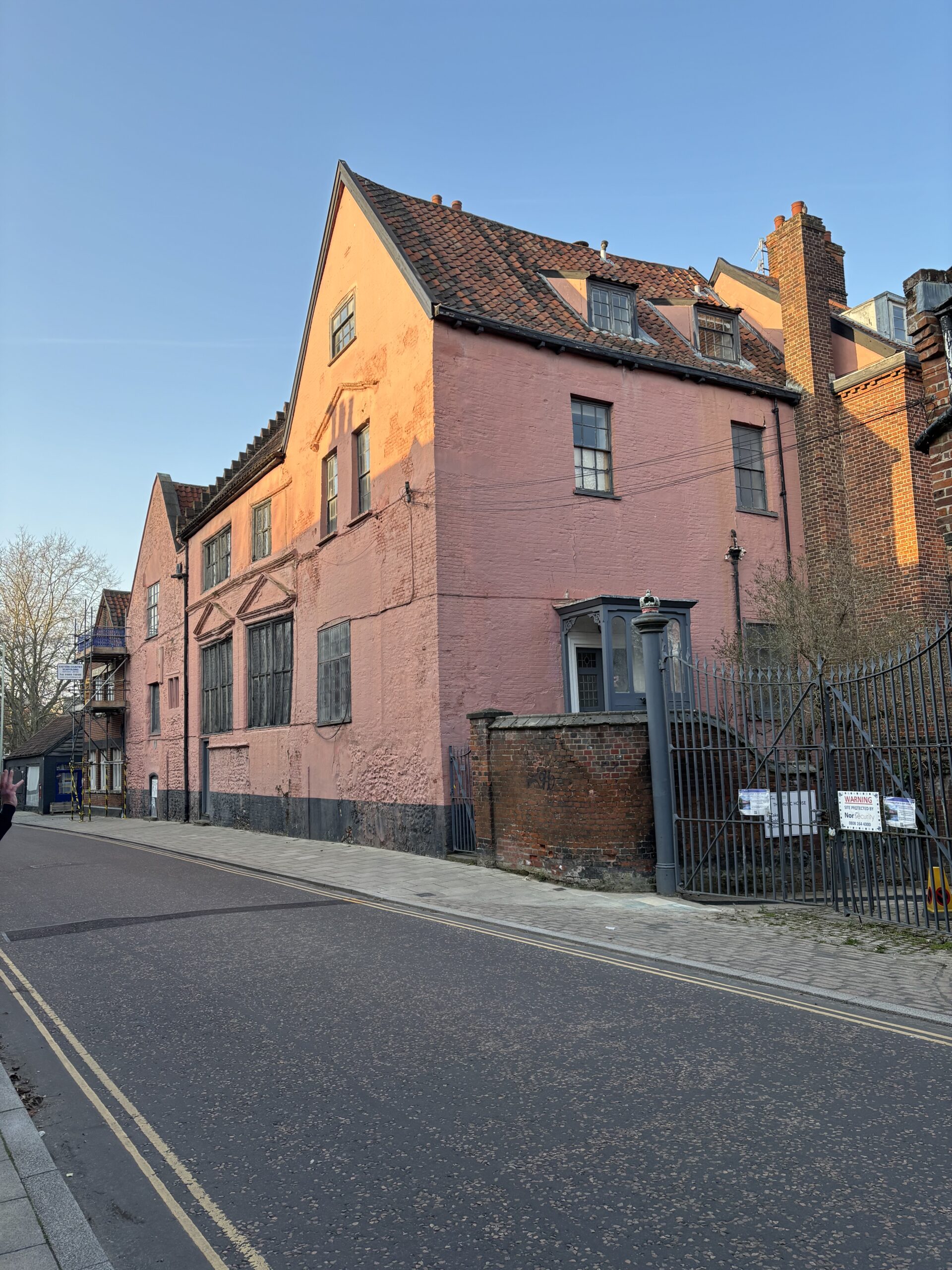
Further down the street southwards, on the site of Wensum Lodge, there’s the Music House. The Music House is the oldest inhabited house in Norwich, dating back to the middle of the 12th century. It was built initially by Jurnet, a Jewish family. His son Isaac lived there, and so did his grandson Samuel. The family was on the site for nearly 100 years. Jurnet was a wealthy financier. It’s thought he helped fund the building of the Benedictine monastery that became Norwich Cathedral. Not a lot survives of his house, but the undercroft (the cellars of the Music House) is from the Norman period, so that’s an important survival.
Jewish community in Medieval Norwich
The Jewish community arrived in England with William the Conqueror and made their way to Norwich by the 1130s. At its peak there were probably around 200, and quite a lot of them lived in the White Lion Street area. In the late 12th century we know there were riots against the Jewish community in Norwich. Edward I banned all Jews from living in England in 1290. This happened all over Western Europe, and the Jewish communities were forced to head east.
When Chantry Place was being built in the early 2000s, several skeletons were found in a dry well on the building site. They were tested and it was found they all had similar DNA to Ashkenazi Jews. It tells you what happened to the Jewish community after they were banned from here and Western Europe. All they could do was move east. It’s a terrible story.
The Pastons
The Pastons emerged from Paston. From the 1380s, over a century, they went from being subsistence farmers to being courtiers at the court of Henry VII. That courtier was John Paston III. His father was John Paston I and his elder brother was John Paston II. By the 1480s John Paston III is the head of the household. He bought the property which was eventually called the Music House, and this became the Paston house.
The Pastons occupied the Music House from the mid-1480s to 1613. The Music House had many additions to the structure over the centuries, and the Pastons got involved in this. When you’re walking along King Street and look up, those wonderful windows on the first floor were added by the Pastons in the early 17th century, just before they sold the building.
The Pastons are important because they left the largest late medieval collection of letters to have survived. It’s also the first that talks about everyday life. ‘Please get me some shopping.’ ‘My daughter ran off with someone I don’t want them to marry.’ It shows us that our concerns in the 15th century were very similar to our concerns in the 21st century.
Letter from John Paston II to Margaret Paston
In 1471, John Paston II and John Paston III fought on the Lancastrian side of the Battle of Barnet. John Paston III was wounded. This is a letter his elder brother wrote to their mother, Margaret.
‘Mother I recommend me to you letting you know that, blessed be God, my brother John is alive and fareth well, and in no peril of death.
Nevertheless, he is hurt with an arrow on his right arm beneath the elbow and I have sent him a surgeon who hath dressed him. And he telleth me that he trusteth that he shall be all whole within right short time.
It is so that John Milsent is dead, God have mercy on his soul. And William Milsent is alive, and his other servants all be escaped by all likelihood. As for me I am in good case, blessed be God, and in no jeopardy of my life for I am at my liberty.
Item, my Lord Archbishop is in the tower. Nevertheless, I trust to God that he shall do well enough, he hath a safeguard for him. Nevertheless, we have been troubled since but now I understand that he hath a pardon and so we hope well.
There was killed upon the field half a mile from Barnet, the Earl of Warwick, the Marquis Montagu, Sir William Tyrell, Sir Lewis Johns, and diverse other esquires of our country, Godmerston and Booth.
And on the King Edwards party, the Lord Cromwell, the Lord Say, Sir Humphrey Bourchier of our country, which is a sore moaned man here. And other people of both parties to the number of more than a thousand.’
The earliest Valentine
By the time John Paston III bought the Music House, he’d married a lady called Margery Brewes. He played rather hard to get because he wanted her father to provide more money for the marriage settlement. Margery is believed to be the person to have written the first Valentine. It was written in 1477, and it goes:
‘My right well beloved Valentine,
And if it pleases you to hear of my welfare, I am not in good heel of body nor heart, nor shall be till I hear from you. My lady my mother has laboured the matter to my father but she can get no more than you know of.
But if you love me, as I trust truly that you do, you will not leave me. For if ye had not half the livelihood that ye have I would not forsake you.
And if you command me to keep true wherever I go, I trust I will do all my might you to love. And if my friends say that I do amiss, they shall not let me so fore to do.
My heart me bids evermore to love you truly over all earthly things. And if they be never so wroth I trust it shall be better in time coming.’
In the letter that Margery is obviously declaring her love, but she’s also telling him ‘look, mate, we can’t get any more money out of my father. That’s it. Please, I love you. I want to be married to you.’ And of course they do marry, so there’s a happy end to the story.
Music House after the Pastons
The Pastons sold the house to Sir Edward Coke in the late 17th century. The Cokes were there for just over 100 years before they sold it. We know that the site of the house was occupied by a brewer called Edward Hunton. We don’t know whether he was brewing in the house or not, but he was on site. Edward Hunton then sold the site to Youngs in 1812.
The brewery becomes known as Youngs, Crawshay’s and Youngs. They were there 1812-1958. The whole site that Wensum Lodge occupied was the brewery. Much of the brewery was destroyed in the 1960s when Wensum Lodge was developed. Youngs brought the Music House in 1865 and established their brewery tap in there (the brewery’s pub). That ran until 1932. The Music House was also home for the chief brewer and used as offices as well. Their architect’s department and their accountancy department were in there.
Youngs, Crawshay and Youngs was an important Norfolk brewery that had lots of pubs in Norwich and in the county. In 1958, another Norwich brewery called Bullards brought Youngs purely for their pubs. The site was thus left vacant at the end of the 1950s. The education committee moved in and developed the adult education centre Wensum Lodge.
Origin of the Name ‘The Music House’
The name ‘the Music House’ comes from the Norwich Waits using an area within the building to practise. They were the official Norwich musicians who would perform for the mayor. They started rehearsing during the Elizabethan era, so the 16th century. They were disbanded in 1790. So they used the Music House to rehearse for all that time, and that’s where the name comes from.
Modern King Street
There were more than 30 pubs on King Street in the past. I find that incredible, actually. I always talk about that when we go past the last pub standing on King Street. It shows how life has changed so much. Most of the pubs would have just been beerhouses that people ran out of their front rooms. But society was so different and low alcohol beer was the safest thing to drink until after World War I. The courts and yards, of which there were many in this area, had very poor facilities. People who lived here would have had to get their water from the river, which wasn’t the cleanest. There was an open sewer and byproduct of the woollen cloth dying industry. So pubs were very important and glued society together, but times have changed a lot and now there’s only one pub left on King Street.
The really good thing I think about King Street is that so many people live here now. During the day when I’m doing a guided tour, I don’t see many because they’re all at work. It’s pretty quiet here at times. But that’s been one of the great developments of King Street, how people have moved back into the street. And having somewhere like the National Writer’s Centre here is incredible. That’s a busy place, lots of events, people coming and going, and that helps give the street life. So does the Waterfront. It’s been more than 30 years since the Waterfront has been in action as a live music venue. And long may that continue.

Paul Dickson (b. 1955) talking to WISEArchive in Norwich on 24th March 2025.
© 2025 WISEArchive. All Rights Reserved.
