Steve tells us about his 18-year career in Norfolk’s Mobile Library Service, from delivering books to isolated hamlets to providing community support throughout Covid.
I joined the Mobile Library Service on April 1st 2008. My role was Lead Driver.
It started off quite a simple role, going out to libraries, assisting people, doing some DIY around the libraries, documenting vehicles, and various other things. I started to write policy stuff; I rewrote the Health and Safety Risk Assessments and Control folder which took quite a bit of time. There were risk assessments previously but they hadn’t been taken very seriously and this was bringing a whole new thought to the work environment.
Whilst I was doing that, I also wrote a driver’s handbook which encompassed pretty much everything the driver would meet during his day from the daily checks to filling accident paperwork out, speed limits and the list goes on…
Another project early on was between myself and my manager, who had also been in their post maybe two years, was looking at how our delivery system was working. It used to have large euro style boxes, people would fill these boxes full of books and they would weigh anything between 20 to 30 kilograms. There were a number of manual handling injuries where people would move the boxes together or singly and put their backs out. We went to various trade shows and we came up with a totally different way of doing the deliveries.
We got the boxes down half size and the maximum weight you could put in was about 10-15 kilograms, which was well within the capability of most people. We devised a trolley that these boxes would sit on and a lid to go over the top so it was all contained. It could be picked up from a library, wheeled onto the truck and secured so it would cut down manual handling. I’m not aware of any more manual handling injuries involving moving books and stuff. I suspect there were people that had paper cuts and maybe the odd thing like that. I suppose that took 18 months from the start to have it in operation. A lot of the libraries at the time felt the whole process was big, cumbersome and awkward but I suspect that’s because things have always been ‘that’s how they did it’ and change was a bit of a struggle.
Over the years people went, people got used to it and staff members are seeming to be quite happy with the whole system now. Probably took about five or six years for the system to fully bed in.
There were two aspects to my role as lead driver. There was the mobile library team and the delivery team which, at that time, I was probably more involved with as I was their immediate supervisor. There are 47 libraries around Norfolk and they would deliver boxes of books and resources – it could be tables, all different things. So, they would go around to all these libraries on a scheduled route. At that time there were four drivers and they would move something in the range of 3,000 items a day, per vehicle, so it was quite a large operation.
Cutbacks
There were four trucks and four drivers but as austerity hit, those got reduced to two drivers and two trucks. They drive a seven-and-a-half-ton truck and on average it’s about 130 miles a day they’ll drive, visiting anywhere between eight to twelve different libraries. It’s a little service that people don’t realise but it is quite key to all the libraries.
That’s how books get taken from one library to the next library. If you had a book that was in Kings Lynn that somebody wanted in Great Yarmouth, that’s how the book gets to that reservation, the delivery team would just simply move it around.
So coupled with that, there was also things like accident investigation which I got involved with. If there was an unfortunate collision, I would have to complete all the paperwork, do all the acts investigation and then hand it over to the insurance company to deal with and they would meter out any recommendations for a driver. They might have to have another driving assessment which brings me on to another little job I had to do which was to arrange for drivers to have a driving assessment. When they join the council every driver that drives LGV vehicles has to have a driving assessment by an independent driving assessor and they would have that assessment every three years, which in my personal experience is very worthwhile. When I took the role over, I think my last driving test or driving exam I took was probably 1993 and in my first assessment I learned an awful lot about how newer vehicles actually drive. It turned out I’m pretty keen on the driving assessments and I personally think a lot of drivers would benefit from that in their own personal lives as well.
New driver qualifications and servicing requirements introduced
I suppose another key thing that came along was the Driver Certificate of Professional Competence, generally known as the Driver CPC, which started rearing its head about 2010 and, if memory serves me right, became compulsory in 2014. The driver CPC is a driver that would need to undertake 35 hours of training every five years which breaks down to seven hours every year. In the early stages myself and a lady called Maureen wrote training lesson plans, devised the training and delivered the training, which took an awful lot of hard work. I suppose the driver CPC could be equivalent to what an NVQ is. It is government run. You were audited by one of three people, it could have been DVSA, it could have been JAUPT or it could have, in those days, been another independent body and we did actually have a number of people coming to audit us. That is still ongoing.
Again, it was another training course we had to do. We all had to do the PTLLS course – Preparing to Teach in the Lifelong Learning Sector to enable us to deliver it, so all in all that that was quite a chunk.
A little bit later one of the managers left, a new manager came in, and I was given a little bit more responsibility which sort of came my way. As part of an austerity package, we started to do our own vehicle servicing, so I had to do all the vehicle servicing plans for 12 months, which had to be updated every six months as you had to have six months, always ahead. You had to make sure the vehicles went in for a service. Commercial vehicles need to have regular servicing. Again, it’s all tied down to different legislations, different audits and transport is a funny business. There’s an awful lot of legislation mixed up with it.
The vehicles’ servicing was pretty much every 13 weeks, then every six or seven weeks there would be an inspection. You would have maybe an oil change and then seven weeks later it would be a check of the vehicle make sure that it’s safe to go on the road and then six weeks after that it would have another service. It might need new brakes fitted and it’s all laid down in a document. So that’s kind of the vehicle servicing.
Covid
As we move forward a couple of years, we got hit with Covid and we worked all the way through Covid. We took on a new role with our delivery vehicles. We delivered food to food hubs around Norfolk. We’d have a big delivery come to us. We’d pick it, sort it, take it out to these food hubs, whatever they wanted there’d be an order the day before and they would be picked. So that was the early days. A number of us were also asked to deliver bodies. They were expecting an awful lot of casualties, that’s pretty sad, a number of us were taken up to the central morgue and given instructions how to move bodies during a bad time of the Covid. There was, I can’t remember, maybe 500 morgues built in Coltishall on the old airbase there, but we weren’t asked to support it. That’s lucky I suppose. I think the fireman actually ran that one.
As we came out of Covid, myself and another manager were tasked to open up some of the libraries for the public to start using. We had to put one-way systems and make it safe for the customer. It started off, I think, three or four different libraries and then it was eight or nine and then most of the libraries opened up. Some libraries just weren’t big enough to support one-way systems. So again, that took a lot of time, a lot of effort to come out of there.
Changes post-Covid
Once Covid finished the mobile library manager then moved on and I became the mobile library manager. My role was mobile library delivery service manager. I took on the role around the time there was a further reduction in vehicles and routes. This meant I had to plan all the routes for all the mobile libraries which equates to about 80-odd routes covering about 1000 stops, trying to make sense of where people are and what people want.
There’s significantly less stops than there used to be. When I first started back in 2008 there was about 18 mobile libraries, when I finished there was five. There has been a massive reduction. There has been different criteria with the mobile libraries that I had to follow. It became a political hot potato. So that proved quite a challenge to devise the routes, because not every route follows a pattern. You ideally want to start off at a point, drive around in a nice circle so you’re coming back, but there’s other little things that need to be considered. One-way streets, crossing main roads, weight restrictions is another big one. It took about four months for me to put a route together. Apart from a few little hiccups at the start, it worked well and when I left the service in September ‘25, the routes were still strong and the customer base was actually building.
During Covid we were having to clear the libraries out but one of the things that I think the council were pretty slow at doing was using their resources. Us and the library service had four delivery trucks, half a dozen mobile libraries at that time, and drivers who could drive anything from an articulated vehicle to normal trucks. When we were moving the stuff around, we had to move tables, chairs, bookcases and put it into storage. One of the storage areas that we started off with was up at the old airbase at Coltishall, where we were given access to an old building but we soon outgrew that, and the council then rented a place down in the old Britvic site, one of the big buildings there. I would say tens of thousands of pounds worth of stuff was stored, ready to go back into the libraries. So that all got moved.
After Covid, like many things I suppose, people were maybe afraid to come out. Lives have changed, people’s attitudes have changed. You can just see that in the shops down in the town. People have got used to not coming out.
It seems now at last that people are starting to visit the mobile library again. Even through the reduction we had a couple of years ago in vehicle and routes, we were still maintaining the same number of customers as we were when we had more vehicles, so that’s all fairly good news.
Kindle or books?
My personal opinion is if you’re reading when you’re younger, you’ll be reading when you’re older. People tended to go to Kindle and online stuff, but they generally come back to books. The comment you hear quite often is ‘there’s nothing like the smell and feel of a good book’ and that reading electronic versions hurts their eyes. It could be that the sun’s reflecting off it and they can’t read it where they want. Whereas a book they can put down and jump in the swimming pool or go gardening or whatever. There was a decline, but I think it’s actually picked up because I think people prefer holding a book. I really do.
There’s a comment that you hear quite regularly which brings me back to something that happened when I first started which put me in mind of the whole ethos of the mobile library. There was a little hamlet, we pulled up, and this little old lady came in the van and her comment to me was ‘oh you’re new’, which I was, and she started saying ‘the mobile library is the only vehicle I see from the council. We haven’t got a shop, we haven’t got a school, we haven’t got lights. We don’t see the binmen because they come in the morning and the only thing I see from my council tax is the mobile library.’ A common word, they will say is ‘it’s a lifeline’. It is a lifeline to people and certainly from the managerial perspective, we’ve had to intervene on a number of occasions where a driver had concerns about their customers. They may only see them once a month but, quite often in that month, there may be a deterioration or there may be a safeguarding issue which is starting to show its head. We do highlight that and then it gets followed up. So it provides a service.
Providing a community service
During the last couple of years, we’ve had a number of different people coming on the vehicle. We had a group from North Norfolk District Council that came on a lot of the routes around North Norfolk to find out where coffee mornings were and to understand what people want from North Norfolk District Council. From that they’ve built up a website of community connectors. They used us to communicate with their area, and they’ve now got a list of not just where the mobile library stops are, but also when the post van turns up, because a lot of little villages have a mobile post office van.
We’ve also had in the past, police officers going around their beat, meeting people. A lot of people at a lot of the stops we go to are in very remote areas, so we’ve had a number of politicians travel on the van to their wards. And, in the future, we hope to have a lot of the social services personal assistants go out in the vans to pass on information to the heads of service about what is out there.
Norfolk is a big county and not everybody can cover it as much as the mobile libraries do and I suppose the binmen as well, they go to a lot of places. I’ve probably missed an awful lot!
New vehicles
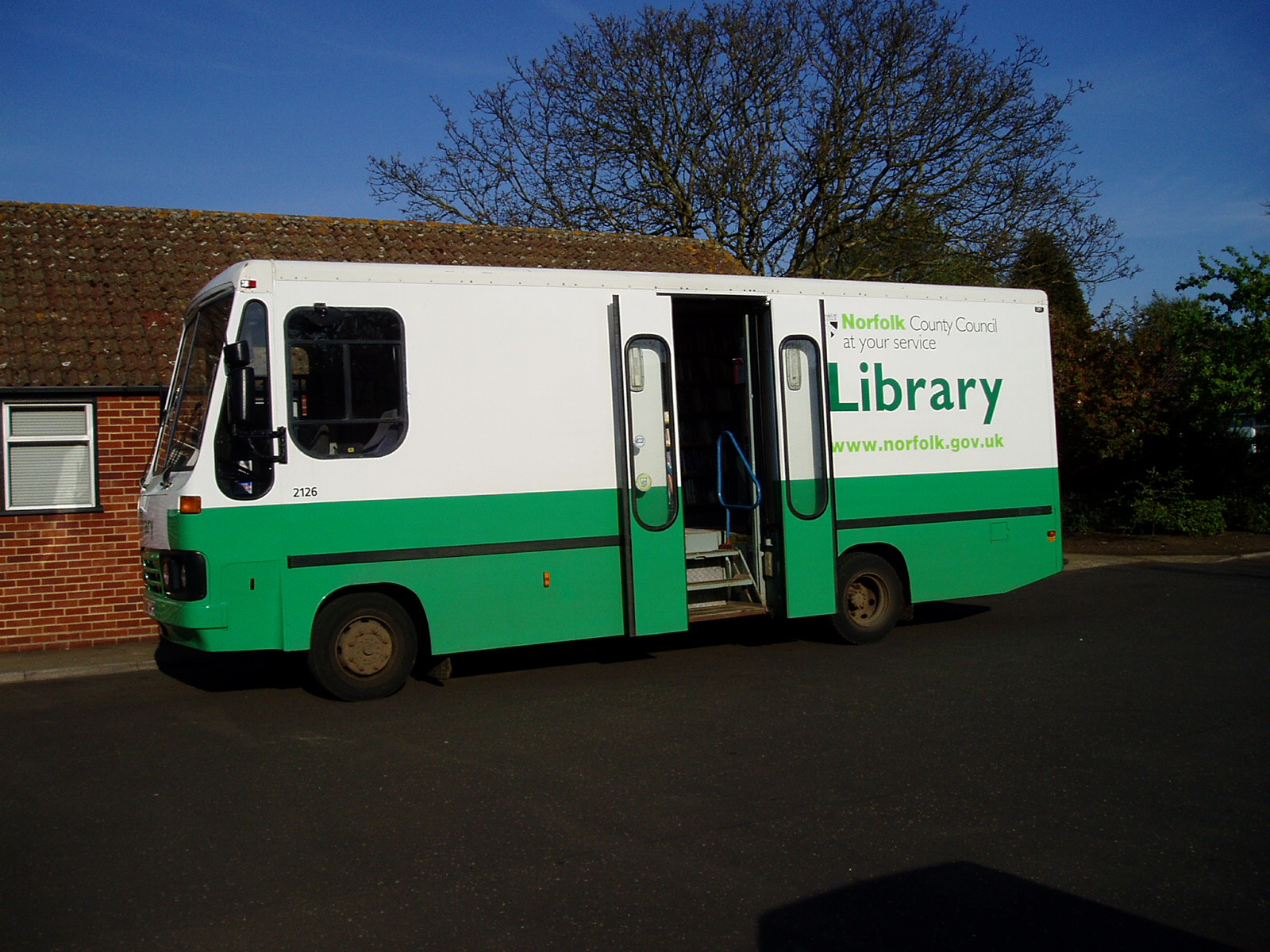
Just recently we’ve had three new mobile libraries brought into service. One came in two years ago and is based at Dersingham. One is in the Central Mobile Library which came in in March and more recently, in May, we got an electric vehicle when an electric mobile library van was commissioned. The two larger vehicles came from Northern Ireland which meant trips there to ensure what we wanted was being fitted. I suppose the one I’m most proud of is the electric vehicle where I was able to help with its design. We actually designed the interior for that and it’s proved very popular with customers and the drivers which surprised me a little bit. The future is looking like going electric, but it is going to be quite difficult with larger vehicles and how they need to recharge their batteries, so I don’t know what the future holds as far as vehicles goes. The electric vehicle is a Fiat, it’s probably the size of a large Ford Transit; it’s got height. I think people like it because it’s light, it’s airy. It doesn’t feel claustrophobic because the size of the vehicle is quite large.
The future of the Mobile Library Service
In the last 10 years Norwich City Council and, more recently, South Norfolk, started using the mobile library as a standby polling station, and the mobile library was earning some money out of that. Basically, should a polling station go down, flood, fire, whatever reason they can’t open a polling station, they had a mobile library that would go out and act as a polling station. The mobile library has internet access, a toilet, power, so you could run a small office in times of desperate need. It would take about an hour or so to fully take all the books out, maybe a bit longer, but if I could see the future, it could be used as a command centre for the council!
So that’s pretty much everything that I’ve done. It doesn’t sound a lot in 18 years, but quite a lot of work went on. My last project was dealing with the 100-year anniversary of the mobile libraries.
It’s a very popular service. It’s a service that customers want and there’s not many services where a customer can walk to get to you. Certainly not council services. But if people make the effort to come out to a mobile library in the summer or winter, they are doing it for a reason so I feel confident the mobile service has got many years ahead of it. People’s attitudes may change but, when I left, I felt confident it would go on for many years to come.
Steven Jones talking to WISEArchive on 6th October 2025 in Norwich. © 2025 WISEArchive. All Rights Reserved.