Graham is an artist who progressed through teaching and management at Wensum Lodge before returning to concentrate on his art. He recalls progressive changes in adult education in Norfolk, as experienced at Wensum Lodge.
The route to Wensum Lodge
I originally come from London and did a foundation to Art and Design course in 1976-1977 at Southend School of Art. From there I went to Norwich School of Art, my first choice. At the end of the three years in 1980 as a fine art graduate I had to find a way of continuing painting and making enough money to live on…
I started teaching in Wensum Lodge as an assistant in 1984. I’d previously done a term in private teaching and I became an assistant to a tutor who taught there. His class had 25 people in it, which was quite extraordinary. The Riverside studio was absolutely packed – there was no standing or sitting space left. Almost straightaway after that I signed up for the Stage 1 Teaching Certificate which helped me to teach and to meet other people who ran courses in the area. After that I was offered a class in watercolour painting at Wensum Lodge. You had to have 12 people in your class to make it run and you were paid a relatively high amount per hour. My aim was to have about 12 hours a week in various places which then meant that I could paint for the rest of the week.
And this was my route. I got 16 people straightaway for my watercolour class, even though nobody knew me. After that, each year I suggested another class and another class, and about 10 years on I’d got my full 12 hours at Wensum Lodge, which was perfect. I had all my teaching resources there and I could walk to the centre. The other classes had been in places which were difficult to get to.
Wensum Lodge was used by lots of other groups because it is relatively central in Norwich and it had parking. At City College, they would have used all their space, whereas Wensum Lodge had several spaces they weren’t using or weren’t using all the time. The Workers Educational Association did quite a lot of classes there and I think the Art School did some, plus the OU.
Changes in the 1990s
To start with I was teaching beginners. I did introduce something called ‘Open College Network’ towards the end of my teaching time at Wensum Lodge – which made classes cheaper, because it was subsidised. Changes in the middle of the 1990s, especially in 1997, made it possible for courses to be accredited, as they called it, which meant it was subsidised by the government.
That was when New Labour came in. There was a new head of adult education. Adult education in Norfolk was huge at that time, absolutely massive. Later on, when I took on a job as a curriculum manager in Art, Craft and Music we had about eleven and a half thousand enrolments across the county. So we ran courses in Kings Lynn, Fakenham and lots of very rural areas – in community halls and in all sorts of places all around the county. It really was a big undertaking.
Curriculum Manager at the jewel in the crown
In 1997 I was taken on as Curriculum Manager – Arts, Craft and Music.
Wensum Lodge was always called ‘the jewel in the crown’ because of the resources held there. When I started teaching in the Riverside Art Studio it had all the equipment you’d need to run a proper art course. Elsewhere in the county you probably were making do, or the tutor would have to bring lots of items in to make the class work.
At Wensum Lodge there were rooms for ceramics and silversmithing. There was an organisation called the Friends of Wensum Lodge who would often pay for new kilns and new brazing booths and all that kind of thing. In fact, one of my last acts before I left in 2014, was to get a new kiln and to have the brazing torches properly connected to natural gas rather than use propane. It was something that improved gradually.
At the start there was some music. Eileen Last did music appreciation and, I think she taught piano as well. I started talking to her about something and I think Shostakovich came up and she started humming Shostakovich in the middle of the street. She was just a magical woman.
My role became more managerial. I always had things in my job description which I had to do but as far as I was concerned I was developing the Arts. I was trying to promote the tutors, who I felt were very skilled and capable in their own fields. Like Eileen, Pat Southwood and Darren who taught silversmithing. All were capable in their own fields and loved them, they did their own practice, sold their own pots, their jewellery, all those kinds of things. I wanted them to be passing that on, but also doing it themselves because they were part of the rich cultural heritage that we had, not only in Wensum Lodge but also in the whole of Norfolk. It was something to be developed, nurtured, fostered – come what may! But a few times I had difficulties just making things keep going. There were problems around funding, reflecting how the arts have been devalued over time.
What I did gradually was accredit a course if I could, because the amount of money that you got for an unaccredited course became harder to get. Courses became more expensive to do so if I could, for example, make it a City and Guilds course like dressmaking, ceramics, silversmithing – I would.
In the end we did quite a lot of high-powered courses like a Foundation to Art and Design (which I’d done myself in Southend) at Wensum Lodge, just because they brought in so much money. I heard the Art School had stopped doing it and went to see the Principal. She said it was because although huge numbers started they also got a huge dropout: At Wensum Lodge we started in a small way and I don’t think we ever lost anyone, because there were small groups and they knew we cared about their development. It was a big course for us to do. Whereas the Art School had started doing MAs – you know, Master of Arts courses, so the Foundation course really was low on their agenda.
However, often it was a requirement to do a Foundation to get into Art School. We got somebody into the Slade, and somebody into Cambridge to do Art History. The record was pretty good. We also did a Creative Writing and Access to Writing course – which got several people into Cambridge. We didn’t feel it was properly acknowledged. We had to have what’s called a ‘panel’ for Creative Writing. We had opposition from the local university actually. They said they were not going to take anyone from that course. In the end I just said ‘fair enough, they’ll go somewhere else’. In Norwich – well, people don’t want others to do well sometimes, and you don’t get credit for what you do. You have to say you are doing it for the right reasons – because people will benefit: the learners will benefit, and the tutors will benefit, because they’ll be able to carry on their work.
Changes of emphasis
When I started as a curriculum manager in 1997 I had a good Head of Service and he was supportive of all of his staff. But as things progressed there was more and more emphasis on what you might call ‘skills for work’. Nobody has to do the Arts. And as that happened it meant there was more pressure to prove that it was value for money, that people were properly trained, and it all became a little bit more …functional.
None of that which I was concerned with at that time exists any more – it’s all gone. I’m not saying that’s the County Council’s fault or any of the staff’s fault, maybe not even the Government’s fault but it was a combination of factors that made it less and less relevant. Even though I did say that it was important.
I felt the shift begin in 2001-2, something like that. We responded by accrediting more courses, but in 2010 the shutters came down. Austerity kicked in and you could feel the lack of money in the system.
I didn’t really meet politicians to do my job. I did meet Ian Gibson, the MP for Norwich North at the time because I was involved with something called the Contact Gallery. No county councillors or portfolio holders, either. It was pretty low on their agenda. The head of the Department of Education, whose name I can’t remember, did come to one of my classes as a student!
[Interviewer: Interesting because Wensum Lodge was started by Lincoln Ralphs who was the Chief Education Officer for Norfolk. They had a celebration for 25 years of Wensum Lodge and the Secretary of State Education came for a dinner. ]
Ken and Brenda Davis – Graham’s painting
Ken and Brenda (the Wardens) were pretty good on the political front, they were always bringing people in and naming rooms after them – the Edwards Room and the Lincoln Ralphs Sports Centre and all this kind of thing. They were pretty astute and I think it paid off, it worked. Because they developed the place no end. They were responsible for the improvement of rooms and facilities and all that kind of thing. They just chipped away at it, improving it gradually. They did get recognition for that, which was great. They set up Friends of Wensum Lodge which was very active in the beginning.
I think it was the 25th anniversary in 1990, they commissioned a painting from me of the site. It’s a long painting. I had to stand in front of the annual general meeting and explain what it was going to be and what it would look like and all the rest of it. It was in the Crown Room and there must have been at least a hundred people in there.
I don’t know what happened to that painting. Somebody told me it was up about five years ago. It showed the Davises, some of the tutors and the people that ran Jurnet’s Club.
There was one character in it carrying his rifle. There were two shooting ranges; one of them was underneath the ceramics block so if you were there in the evening sometimes you’d be making your vase or something and there would be a great ‘pop’ and another couple of minutes later they’d be another one. People’s work, I think, suffered from that. They were an amateur association that used the facility and came in. There was a little alleyway to the side and I think they got access that way.
There were all sorts of funny little things like that – there’s all sorts of richness there, let’s put it that way. As a site to run educational courses, it was mad. But as a site in which all sorts of wonderful things could happen, it was really good.
Leaving in 2014
I left in 2014. The people who managed the Service wanted to take the unaccredited courses – the Arts generally – in a direction that paid for itself. ‘Self funding’ or something. If you were running a course, say, in Creative Writing in Downham Market, it would be for a full fee. Fees were subsidised by the County Council to a certain degree, and what they wanted to do was run more premium type courses with, say, well-known authors to run them. People would pay twice or three times as much. This actually has happened. I read of a painter who runs a gallery up in Cromer, and he also does courses. The actual cost of the courses per hour is far greater. We did courses in Cromer, but not anymore. You’d have to do it privately now.
We were supposed to take full cost, and I think I made it fairly clear that I wasn’t going to do that. I didn’t believe in it – I don’t think it works. You’ll get six people paying full cost, but you won’t have any room for subsidy, for example concessions for over 60s. So you probably lose a couple of people. You take off the subsidy for people who are on benefit and you lose a couple more. So you’re left with six people who will pay double the usual fee. So instead of, say, £6 an hour, it would be £15 an hour. So to do a course of say four hours on a Saturday, you would be paying £60 instead of £15. I didn’t want to be part of that and left with voluntary redundancy.
Graham’s own artwork
I kept up my own artwork and would go off on Saturdays and just paint for a few hours on the beach or something like that. All the time I’d been a tutor, I’d spent a lot of time on paintings. I’d had an exhibition in London in 1996 and at that point it kind of came to an end because I couldn’t spend that amount of time on each picture, so then I changed my practice when I changed my job. I managed to carry on painting but they weren’t the same kind of pictures.
Teaching takes it out of you. twelve hours is about right. Twenty hours teaching means another ten for preparation so you’re doing virtually full-time.
Different types of student
There should be room for different styles of teaching, different ways of people exploring what it might mean for them. You could see some people weren’t going to learn anything in particular, but they just got so much from being there. And other people really did learn a lot very quickly, and ended up selling their pictures. Several of the students I’d had became tutors – because they were motivated and they’d picked it up and ran with it.
I don’t think there should have been just one outcome. We ran relatively high-powered courses towards the end of my time but we still wanted to run those you could come to and hopefully be helped to get what you wanted from that sort of course. For some people, just, just doing was enough. Just ‘do’ instead of trying to make them into better painters.
I also taught in other settings, like daycare settings and hospitals for Suffolk Social Services.
Lifelong Learning
I did an MA in Lifelong Learning in 2000 with the Open University. It was about seven Saturdays a year and a lot of books to read, a lot of big essays to write. I did that just because I felt that I didn’t know enough about Education as a subject, because hitherto I’ve just been scraping together 12 hours just to fund my own practice. I learned what you might call the theoretical underpinning. So I understood what it was about – how we might go about assessment courses, that sort of thing
Looking back at my working life at Wensum Lodge
Now I’m in Lowestoft and concentrating again on my art. I haven’t got all what you’d need to do continue teaching. You need to put your own concerns out of your head and actually focus on other people’s and come up with the resources.
I had that opportunity to fund myself through part-time teaching. I don’t know if there are enough opportunities for young people to do that now. People can teach in schools, or further education colleges and if they’re very lucky, or well connected, they can teach in art schools. But you have to be qualified but I kind of fell into it, actually. It’s a system of liberal education that’s really gone, I think.
Most of my working life – 30 years was in Wensum Lodge. Started in 1984 and finished in 2014. I met some remarkable people like Eileen and a scientist as well who had been part of Nobel winning team looking at how digestion works; I met Sir Edmund Hillary’s sister, who was a distinguished scientist herself.
The Davis’s, who definitely ran it while they were there, were open to all sorts of ideas and they would give people a little bit of wriggle room to do things. When computers started to come along in the early 1990s, they set up a computer room and did the courses somehow. Then they used the money from the courses to get more computers or something. That’s the way they did things, and it worked.
I can’t see Wensum Lodge coming back in any form. It is now part of King Street that’s about to be developed. A set of building sites really. Thet lower part will probably not be developed for another 20 years or so I wouldn’t have thought. There are several sites that have laid empty and dormant. There’s one which is right next to the Sports Hall, the Stores, near the Novi Sad Bridge and that’s been empty for I don’t know how long.
The front of the site that the City Council owns is looking for another life because you can’t knock that down, you can’t make that into a hotel.
The Theatre and Jurnet’s
One of my early things when I became a manager was to try and set up an improvisation acting group on Friday nights in the old theatre where one acting group had performed the whole of whole of Shakespeare’s canon on this very small wooden stage at the top of Wensum Lodge.
I had to teach in the Theatre for a few years for one of my classes. It was a bizarre place to come to because there were steps from the outside to the first floor – and if you carry on up the steps, you go up to just under the eaves, and you can see the beams that make the roof.
When we first set up the Foundation course we used the Theatre as the base, because nobody else wanted to use it. We had 12 students on the course and it was the place that they could go to do their work for their own projects. We did life drawing in the Riverside Studio and ceramics in the Ceramics Studio, but their base was in this theatre. I’d apologise but they said ‘oh no, we love it! We think this is great.’
Jurnet’s Bar was also used by the students, it was where people went. Not so much in the evening but during the day it got very busy because they did food. You could get lunch and coffee and alcoholic drinks. I remember sitting with one group who were the Life Drawing students and tutor and myself. And there was another group from the Antiques Appreciation Class, who were very, very different. They were about restoring quite expensive antiques, and you could feel the tension between these different groups. It was the mix, like a common room.
On that front of the Lodge, there are treasures under the walls and the ceilings which are yet to be unearthed. If you think of, say, the King of Hearts art centre, I’m sure the front of Wensum Lodge even earlier than that – it’s Plantagenet. There’s treasure under the old ceilings and walls.
The mural by Walter Kershaw

The mural on the side of the building was originally funded by the Contemporary Arts Society and Walter Kershaw painted it; he was a well-known painter of murals from the North. So he painted it on boards that got attached to that wall. It’s been restored at least once, since because it was painted in enamel paints and then varnished. It lasted quite well and then in something like 1990. It’s been up for 30 years.
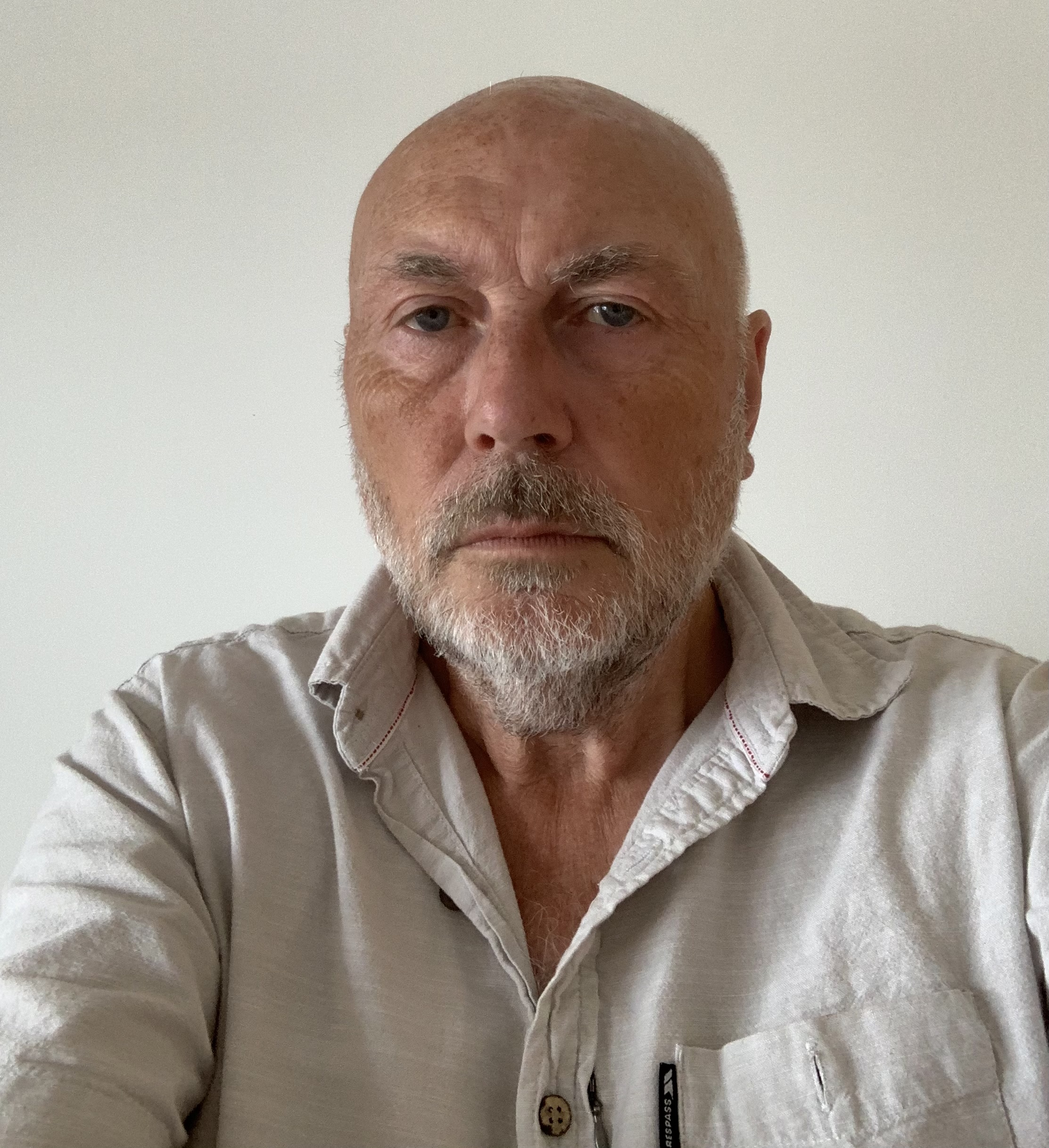
Graham Rider talking to Susan Steward in Oulton Broad on 31st October 2024. © 2025 WISEArchive. All Rights Reserved.