Daniel worked in housing and for charitable organisations before semi-retiring and joining Norfolk Mobile Library Service as a mobile library driver / assistant in 2024.
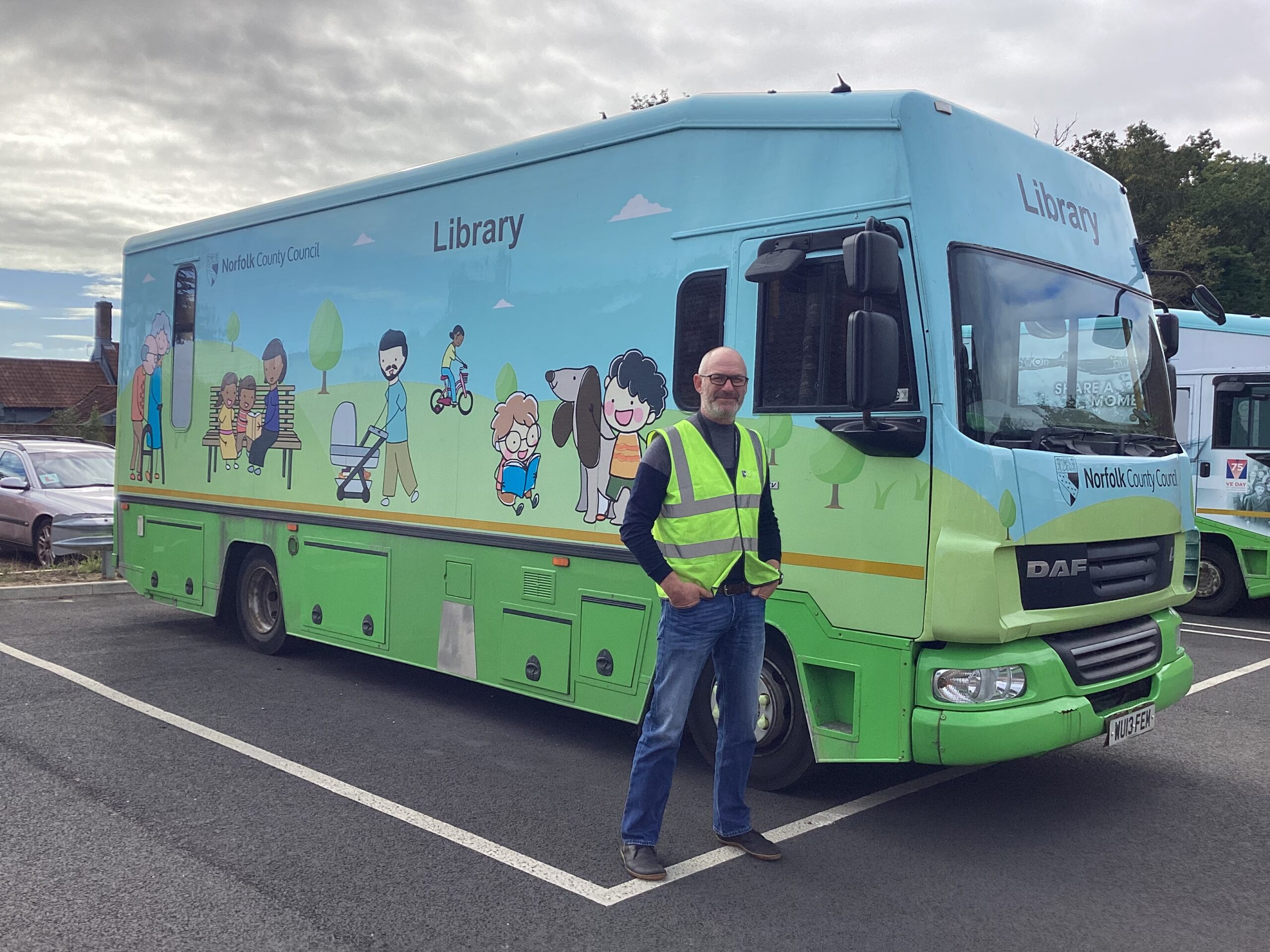
I don’t mind saying that I am 57 and about a year and a half ago, I felt that I needed to start working slightly less in terms of time and commitment. I semi-retired and had always wanted to drive a big truck, that had been an ambition since I was a little boy. The job as a driver for a mobile library bus came up and I thought ‘that’s probably a little bit of me’. So, I’ve been doing this for almost two years now.
Wherry Housing Association
I started out in housing back in 1994 when I went to work for a registered social landlord called Wherry Housing Association. I started advising individuals on their right to buy their council properties and then various other shared ownership schemes.
So, housing really was the entry point for my career and I found in my time working with the housing organisation that I became more and more interested in the social side of what we were doing, what was happening in people’s lives.
Wherry Housing Association became part of one of the first housing group structures in the Country, Anglia Housing group. The group took on two new local transfers of council stock in Harlow and Basildon and the stock was not good quality housing. It tended to be that the residents had various issues going on in their lives, they had complicated lives.
Some of the issues were focused around youth and I wanted to learn more about what we could do about that. The reality was that the money for that side of things wasn’t really there. To me at the time it felt like the social housing movement was focused more on the fabric of buildings than of communities.
A great deal of those housed in the Harlow and Basildon estates were second and third generation London overspill. I found it interesting that a lot of the social issues on the estates were around youth, such as lack of aspiration and lack of opportunity for young people. The lack of aspiration was often intergenerational, with poor or even a complete lack of effective role modelling. The perceptions about the young people on the estates from older and retired people living there would often focus on the poor behaviours as opposed to encouraging and creating opportunity. I could see that a great deal of the work required would be in helping to address life opportunities for the generations to come.
I ended up writing the first community development strategy for The Anglia Housing Group, as basic it was at the time it was at least a start. The business really was only interested in the fabric of the buildings and taking the rent. It was quite mechanical, whereas I was more interested in what was going on in those people’s lives.
King’s Trust
I went to work for an organisation that I felt was doing something effective in that space, The Prince’s Trust, now known as The King’s Trust. That manifested with me taking a job as a Team Leader for the Prince’s Trust Volunteers Programme in Thetford. I can honestly say that this was one of the most challenging and developmental years of my life; working with group of 10-15 young people aged 16-25 and who were not in employment, education or training. The programme focused on how we could help to give them equality of opportunity so that they could move on in their lives in whatever they wanted to do and I came to better understand some of the endemic issues that exist across some of our communities.
The Trust had a whole series of different programmes and interventions that it ran. Following a re-structuring of the charitable business I ended up running the Trust in Norfolk. Running a charity like this gave me a very interesting insight into how our County works at that level. Whilst he was the Prince of Wales at the time he would often visit Norfolk and the Trust is close to his heart so I got to meet him on a couple of occasions. This presence and the network around the Trust in Norfolk focused my attention less on delivering services and more on raising the income required, looking at the strategic side of how a charitable organisation operates in the county.
Big C
A job as a Chief Executive for a local cancer charity came up and I felt I was ready to step up for that, so I became the Chief Executive at the Big C.
It was not a huge charity when I started back in 2006 and to cut a long story short we really established it as the local cancer support charity. We brought the lived experience of people affected by cancer together and developed an infra-structure of psychosocial support which worked alongside the acute clinical pathways of the hospitals. It really brought me to a much clearer understanding of what’s going on in people’s lives outside the major trauma of an acute clinical episode and how we can provide more support for people in those areas.
My Big C experience was that we were successful as a charity, growing exponentially with support centres across the county and a dozen charity shops helping us to generate the income. The model was very simple, we simply asked people living the experience of a cancer diagnosis what they needed and provided it. We continued to test and learn, always keeping that lived experience at the heart of service development. A cancer diagnosis cross cuts society and many people would give back to the charity to thank us; through the shops, through fund raising events & perhaps most importantly through gifts in their wills. The charity did very well, I really enjoyed the experience and was there for ten years.
Burn out
I don’t mind saying that I was completely burned out at the end of that ten years. I hit 45 years old and experienced a substantial breakdown in my mental health. I spent three or four months unable to get out of bed. I just realised that I had put everything into my career. I’d also had a busy life outside of that; married, two children, all very lovely and very successful but I had left too many parts of my life unattended, I needed a reset.
I’ve got to say it took me quite a long while to deal with my breakdown, it wasn’t just exhaustion over years of hard work, it was more the manifestation of a number of negative behaviours that had become embedded through my earlier life experience. I took the time to understand these experiences with a specialist clinical psychologist. Looking back this was one of the best, and most liberating experiences of my life, but it was also one of the hardest.
It took me a while to then think ‘what am I going to do?’ There was probably some compromise in that decision at the time because I needed to earn money to support my family as well. I left the Big C and set up my own business, YourNorfolk. It is a consultancy vehicle which allows me to use my own lived experience to try and help other people working in the Voluntary, Community & Social Enterprise (VCSE) sector.
For the next eight years I took on a number of roles, some substantive and some temporary, supporting a wide range of Norfolk VCSE organisations. Towards the end of this period I spent more time working with statutory partners as we look together at how to best integrate VCSE specialist services across health and care pathways. I spent a year working for Norfolk & Waveney NHS helping to develop our VCSE ‘Assembly’ to better facilitate this work and I remain of part of this today. Since starting on the mobile library bus I have also maintained a small portfolio of about half a dozen VCSE leaders for whom I provide bespoke mentoring and / or coaching to support them and their organisational needs.
Mobile Library Service
As my family was growing up, about two years ago I decided I wanted to make a more substantive change and it was then that I came here to start this job, working part time on a Monday & Tuesday with the Mobile Library Service.
I started at the beginning of April 2024 so I’ve been on the mobile library buses for almost a couple of years now and I can say with my hand on my heart that it’s the best job I’ve had in my life. Perhaps that’s something to do with where I’m at in my life as well but I love everything about the job, especially fulfilling a childhood ambition to drive a big truck, I’m really enjoying it.
It gets challenging whenever the trucks have problems but I also enjoy that. It feels like an office and a sort of home on wheels too. I’m out in the country every day that I’m working across our beautiful county of Norfolk.
Aside from fulfilling the ambition of driving a truck I came at this role from a perspective of wanting to signpost some of the wonderful VCSE services we have across our county, it wasn’t really about the books for me at the start. Books were never my thing and if I went back, I’d probably diagnose myself as being slightly dyslexic. I always struggled to read books myself. If I’m honest, it’s the advent of audiobooks and the access to audiobooks which has really opened up my own learning. I think I would say that different people access information in different ways, so as a service we’ve got to try to be diverse in the way that we offer reading for both learning and for leisure.
The service
The service runs Monday to Friday, so five days a week. We have three buses that run regularly out of Hethersett, another bus that runs out of Dereham and one more that is based in Dersingham.
That’s five buses in total and each of those buses will do a route most days. There is a cycle of routes which repeats every four weeks, I don’t know how many routes that makes it, it’s about four or five hundred, something like that in total.
The routes we go on are all very defined and each stop will vary in length depending on the clients; sometimes an hour, sometimes maybe ten minutes at another stop. Each route develops an established clientele and we get to know those people really quite well.
Building relationships
I’m out and I’m meeting people whose lives are interesting, diverse and sometimes complicated. I’m able to build a relationship with them because we get to know each other over time on a human level. It might be about the latest Elly Griffiths novel, she’s popular at the moment, but actually we’re getting to know each other on a deeper level and we’re building trust.
When people come on board and there’s something happening in their lives, my experience of working in the voluntary sector enables me to signpost suitable services. That is a joy that I cannot express, when people come on board and they literally haven’t heard of a service that I know is perfect for them; such a joy.
I guess when I first saw the job a year and a half ago my vision was just driving a big truck around the country, listening to my books, reflecting, chilling out a bit and having a bit of personal space. I realised that I could also do the signposting and the kind of empowering practice which has been a theme running through the whole of my working life. So it definitely feels like it is a great way of helping people. It’s also about information sharing and helping people on their own learning journey, which is what libraries are all about.
Demographics
Our main demographic is typically the mature female, but it’s quite diverse. I would say its predominantly older people but let’s bear in mind that we’re there between nine and five on a Monday to Friday, so it’s people who are at home. So older people are most typical although we do get a fair few mums with younger children coming on as well. We do try to target a lot of our stops at primary school and toddler group locations because it’s helping to get them reading early. Those stops are some of my favourite, it’s just so beautiful.
In the back of every bus, we have little carpet mats and a couple of shelves of what we call the flippers, I don’t know why, but they’re just the great big books that as young children we used to love. You’d open the page and there’s one or two words and just beautiful pictures. When you watch the really young ones open them, it reminds me of what it was like when I was that age. To actually open a book and see a different world, to stimulate the imagination and that’s all you want to do.
For me the love of books isn’t so much the books themselves, it’s about stimulating your imagination. There’s lots of reasons why that experience can be difficult for people to access. Sometimes it’s about trying to help mum or dad to understand how important that imagination space can be for their child and for them. Watching that evolve is a real joy.
Book selection
The audio side is really increasing but in terms of the stock we carry on the buses at the moment, there’s a sort of cross section of non-fiction stuff, a bit of history, a bit of local Norfolk, a bit of hobbies and craft, there’s also lots of sewing and knitting, that kind of stuff. We try and take a top slice of what people might be interested in, air fryers are big at the moment for example.
It’s a pretty good cross section and we try and refresh the stock as much as we can. So quite often we’ll just have a purge, we’ve got a gizmo now that can literally go along and read all the books that are on the shelves and tell you when it was last taken out. So, if it hasn’t come off the shelf for a period of months we’ll take it off and refresh. Resource to support this is built into the mobile library team and we work well together, it’s great.
We have a fairly large fiction section which gets updated with the latest releases and all the rest of it. Crime is very popular and a lot of our demographic still like the Mills and Boon romance and the war time sagas. We have a selection in large print as well and we also stock audio book CDs. Actually, a big part of what we also do is helping more and more people with digital access to library stock and services through applications like Libby & BorrowBox. If you are a member of the Norfolk Library service, you can pretty much access any magazine you want via the Libby app for free, but a lot of people don’t know that. So, helping people to access the magazines, newspapers, e-books & audiobooks electronically via these applications is a real joy. The barriers are usually technical & with patience and trust nearly everyone can be supported to access these resources for themselves.
On the road
Actually, one thing I should say as well is, remember these are mobile libraries. We’re driving around and occasionally when you’re driving you will have to make an emergency stop or you might hit a particular rut that makes the bus rock a little bit from side to side. The books don’t always stay on the shelves. There’s nothing worse than driving back down the A11 and having to hit the brakes for whatever reason. You end up literally wearing the children’s section which flies from the back to the front of the bus and knowing that you’ve got about an hour’s worth of restocking the shelves to get them back in place. It does happen.
Signposting
One of the main reasons I wanted to make this record of my experience was just to capture some of that signposting work which I think is so important. We’re living in a time where community support, psycho-social interventions and just being alongside ordinary people in the community has been on the retreat for a couple of decades.
Through most of my professional life it has felt as if society’s investment in this space of stimulating, supporting and encouraging that community cohesion has diminished. That’s why I’ve come to do this, hopefully for the next ten years or so of my later working life. The following is a story which I think illustrates this space really well:
Large print?
I was out on one of my regular routes and one good thing is that I know pretty much who’s getting on at every stop now. So, if they’re not there I can go and knock on their doors and make sure they are alright.
A lady got on at a stop who didn’t normally get on, I’ll call her Mary for the sake of this story. Mary came up to me and asked, ‘Have you got any large print books?’, I replied ‘Well yes, we have got some large print’. So I took her and showed her the large print section in the back of the bus.
Very quickly, within about two minutes, Mary came back to me with one of the large print books and said, ‘Is this the largest print that you do?’ I said, ‘Yes, I’m afraid it is the largest print that we do.’ She was disappointed, I could see the fear and anger in her eyes. She said, ‘Well, it’s not large enough.’ I replied, ‘I’m really sorry, is there anything I can help with?’ It was at that stage she said, ‘Well I’ve been diagnosed with macular degeneration.’
If I’m honest with you, I don’t understand exactly what macular degeneration is but I know it is a degenerative condition that can greatly impact your sight, so it’s scary for people. I could see the fear in this lady and with my background I knew straight away that Vision Norfolk could help. Vision Norfolk is one of the oldest charities in our county, founded over 220 years ago. When combined with an understanding of and access to the latest specialist equipment and treatment pathways the team at Vision Norfolk have been able to stand alongside Mary & empower her to take control of her condition.
Mary now regularly comes onto my bus at the same stop, she takes time to select books from the whole stock which she is now able to access with the aid of specialist equipment. Not only can Mary keep reading, she feels empowered to live her best life independently.
I think this story highlights some of the shortcomings in our current health and care system. The outcome in this case is positive because I happened to be the driver on that day and she happened to come onto the bus. What we need are better systemic ways of ensuring that every person is able to access empowering, preventative and early psycho-social support; helping them to take greater control of their own lives and addressing symptoms which will otherwise become more acute.
Information access
For me, this story illustrates exactly why I came to work on the mobile library buses and I think our future as a service is absolutely in this space. It’s giving people books, its giving people access to knowledge, to information, to pleasure and enjoyment. It’s being able to read whatever you want to read but actually it’s also that space where people are able to connect to wider services, support and information. It’s one of the few statutory services that we still have that exists in this space and thankfully in Norfolk we’re still investing in it.
I think our opportunity is to determine how do we best utilise this investment, this wonderful opportunity to get out into our communities and make real connections with real people. Being able to connect people who are in need to the services that we have to support them, ahead of waiting for them to completely break down and then having to fix the problem for them in a much more acute, disempowering and expensive way, which is our current very ‘medical’ model of health and care…..I’ll get off my soap box now!
Funding
As far as the future funding situation goes, I joined the mobile library service just after a raft of cuts brought about through funding pressures. My own view is that ‘funding pressure’ is a narrative we choose. Perhaps instead, we could choose to have a different narrative, perhaps one where greater resources are allocated where inequity exists across our communities.
I’m interested in taxation and government policies and all the rest of it but at the end of the day investing or not investing in empowering opportunities is a choice that we make as a society. For the last twenty years our leaders have been talking about ‘funding pressure’ and have continued to cut funding across a raft of preventative interventions led by VCSE organisations, but let’s be clear; the ‘funding pressure’ comes from the choices made by those we elect to represent us.
The future
I think the future really depends on how we, as a society, decide that we want to invest in our communities going forward. The Mobile Library Service has been going for 100 years and there’s a reason for that, it’s fundamental to empowering practice. Books are knowledge, equal access to information is about knowledge and knowledge is empowering. So I think that to erode that could be really dangerous for those of us who aspire to a more egalitarian society.
We’ve got a lot on the horizon at the moment with local government reform, so we don’t even know who will have responsibility for running the library service as we move forward. Whoever does, I think it’s actually inherent in a modern civil society to maintain a service that provides that opportunity for equality of access to information.
Daniel Williams (b.1968) talking to WISEArchive in Norwich on 6th October 2025. © 2025 WISEArchive. All Rights Reserved.