Mary Anne talks about her life in adult education, as both a volunteer and a paid professional.
My route into adult education
I was born in 1953. I grew up in London and outside Reading, and studied History at North London Poly. I then did a year’s PGCE in Primary Education. What interested me most there was the maths teaching, but there were far too many teachers at that time and it was difficult to get a job. So, I worked in a children’s home, before getting a part-time job at an infant school in London.
My husband and I moved to Leiston, Suffolk just after my daughter was born. We’d been renting a GLC flat in London and didn’t think it was a good place for our child to grow up, but we couldn’t afford to buy anywhere in London. My parents had moved out of London not long before and my husband was born in Ipswich, so Suffolk seemed a good place to go. I didn’t drive at the time, and Leiston had good public transport. There was a train station then, although it went in the Beeching cuts. The line went between Leiston, Saxmundham and Aldeburgh, maybe Thorpeness. The station has now been converted into houses, but there’s still a railway line because of Sizewell (the nuclear power station).
I couldn’t get a teaching job in the area, because at that time teachers were very fixed in their jobs and stayed for many years. While I did eventually get a bit of supply work, I also did other things.
I did some community arts work and worked in a library. While in London I’d already started volunteering for an adult literacy project. After I started working at the library, an ad came round for a tutor for a literacy class in Leiston, so I applied and got the job. In those days, because there was only one class in Leiston, we might have a numeracy student or an ESOL (English for Speakers of Other Languages) student coming to us, because there was nowhere else for them to go. A class might only have 6-8 students, but a lot of the volunteering support was one-to-one because everyone was at a different level and learning different things.
The next class I got was in Woodbridge. I had to take the children to be looked after by someone else and then catch the bus, carrying my bag of resources! I gradually did more and more within community education. And I learned to drive, I needed to! By the time I left, I’d been the coordinator for Suffolk County Council for literacy, ESOL and numeracy, and was the staff development officer (or whatever they called them). I organised all the basic skills training for the tutors. I also worked with Suffolk College and West Suffolk College, and together we set up the skills for life training for tutors. I developed the Level 2 for the volunteers, and the initial tutor training, and I was involved in the numeracy tutor training for the Level 4.
I also took adult education classes myself. I thought if I wanted to keep working in community arts I needed more art training, so I did a foundation course in Lowestoft. I then did a part-time art degree in London at the same time I was working as the organiser for basic skills in Leiston. My children were still quite small then, so I was busy!
Challenges working in Suffolk and Norfolk
It’s difficult to say what I found challenging working in Suffolk and Norfolk, compared to in London. In London, I was just a volunteer on a scheme working one-to-one with a student. Then gradually I was working more and more with groups and with training, and it was all much more structured. I can’t really separate what I saw as challenging for me, and how community education was changing anyway.
There were challenges for people who’d done the courses in Leiston, as there weren’t things they could necessarily progress on to, because the travelling distances were too far. They may have done distance learning courses – there was the Open University, the Open College Network, and the Open College of the Arts.
Working at Wensum Lodge
Before I started working full-time, I worked for the WEA, and I think it was their courses that first took me to Wensum Lodge. Most of the contact I had with Wensum Lodge was through Open College Network (OCN) meetings. The courses I taught were ‘Return to Learn’ (a Unison course) and ‘Return to Study’ (part of the ‘Trailblazer’ project I worked on). The courses were accredited through the OCN at Levels 1, 2 and 3. They were some of the best courses I ever taught on, because everyone did the same thing but could operate at different levels.
In the first assignment, the students had to write about their education and educational experience. Some would write a paragraph and some 10 pages. Another assignment was to find someone to interview, and then write it up. The students used to dread it beforehand, but after the course finished they said it was the best bit! There was a bit of basic maths and statistics as well. So, it was a really good course, and a lot of the students moved on to other things. It was the kind of thing that really transformed people’s lives.
Because of the way the accreditation worked, you had to have meetings to moderate the work because it was all assessed; there wasn’t a test or exam. Later, I was a trainer on the ‘National Skills for Life’ training schemes both Numeracy Curriculum and Access for All. At one point I had to go to Easton College for various courses I was running, and once went to the wrong place because I looked up ‘Eaton’ instead of ‘Easton’! For the ‘Access for All’ training I went to Hertfordshire, Luton, all over the place.
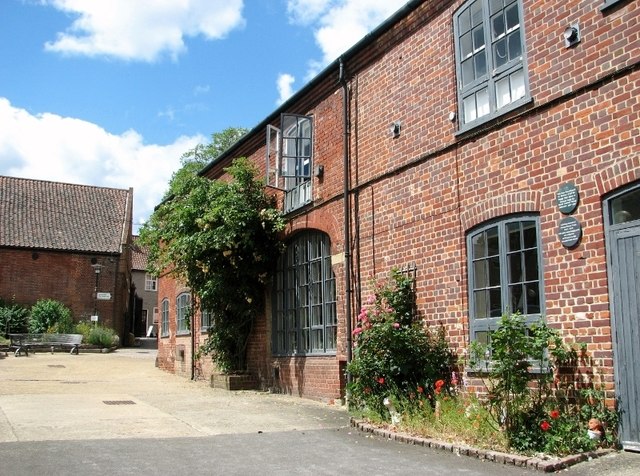
There’s about a ten-year period when I was going to Wensum Lodge about 3-4 times a year. I was driving by then, so I would park at Rouen Road – that was as far as I dared venture into Norwich most of the time! I really liked Wensum Lodge, and I think that’s why it features in my memory. When I look in my diaries I realise I didn’t actually go there very often. I imagine I taught a course there and I may have done some one-off training days, but I wasn’t teaching there regularly. I just liked the building, I liked the atmosphere, and it just felt like a good place to be.
I remember a chairlift for the stairs that ended on a landing, and then there were four more stairs! It was good that we wanted to make courses and places more accessible. That’s what the ‘Access for All’ training was about, how to make your teaching available to people with all kinds of disabilities and circumstances. But part of me regrets that although some of the buildings were really nice, had a good atmosphere and were welcoming in many ways, they were closing down because people were getting more worried about people’s safety. Doors would be kept locked, or you’d have someone there to check who was coming in. I remember working in a community centre in Ipswich when someone complained bitterly to the person on Reception that a community centre belongs to the community, which means all people should be welcomed. I have mixed feelings, because I don’t know how you balance different things; people need to be safe, and they need to be welcomed. It could be very sterile otherwise – and you definitely couldn’t say that about Wensum Lodge!
I’ve kept in touch with some of the people I worked with in community education, with the WEA and the colleges, and there’s many others I remember fondly. We were working together as teams, and there were connections right across the region. It felt like a real community of people with the same aims.
Changes in adult education provision
At the time I stopped being the organiser for the ‘Basic Skills course in Leiston, there was a daytime and an evening literacy class, a daytime numeracy class and possibly an evening one, and an ESOL class, so 4-5 possible classes for people to go to. When I’d left education, I worked for Citizens Advice. We sometimes met people who would have benefited from such classes, but there was no longer anything available in Leiston other than an occasional short course.
That’s to do with the way things are funded; they have to be short courses, and they have to be accredited, whereas we would run courses where people could keep coming for years. If you think how long it might take someone to learn to read and write, coming for just two hours a week, they might need to come for years – and that’s not really available to them anymore.
With the WEA I taught people who worked for the Fire Service and they went from one level to the next and took their accreditation in a very short time, but not everyone can work like that, especially if they’ve got long-term difficulties with learning.
As an organiser I would be based in one of the community education centres, which were often in school-based youth clubs. This wasn’t ideal for adults who hadn’t had good school experiences, but at least the classes existed. And to begin with, I used to go to people’s homes to interview them before they came to a class. Now, visiting someone on your own, and no-one knowing where you were, wouldn’t be considered good practice, but generally it was fine. Now, I doubt people get interviewed at all before they join a class in basic skills, although they may do a test.
You have to be confident enough to know what you want to learn, and how to find it. That was one of the things we talked about regarding barriers to learning; if someone doesn’t read and write very well, you don’t just hand them a prospectus or form about coming to the class! I think it’s more by word-of-mouth; that’s why it really helps to have continuous provision, as people who’ve done a course will tell others. In the ‘Return to Learn’ courses, we often used ex-students to help recruit the new lot.
Being part of a network meant we could meet regularly and share good practice. And Wensum Lodge would be able to tell you about other institutions running classes as well. There’s no focal point now. From the people I’ve worked with throughout my life in different contexts, there are those who will struggle with using a computer, and I don’t know how they get information. Maybe they don’t.
Coming full circle
I’ve lived in Norwich for almost two years. I looked at doing some adult education art classes, as I like to learn and it’s a way to meet people. Somehow though they were either held at the wrong time or are not appealing. I don’t know if it’s me that’s changed, or what’s on offer. The University runs language classes and I’ve toyed with the idea of learning German, but it seems to me there’s not as much adult education available now as there used to be. I think that’s a huge loss.
However, I now volunteer with an ESOL class. It’s a morning session for women, held at St Matthew’s Church in Thorpe. Some of the women are there because they want to cook – they’re living in a hostel and have no cooking facilities. Others come for a coffee and half an hour’s one-to-one English lesson with a volunteer. Their pre-school children can come too; there are toys to play with.
So, I’m carrying on with – or perhaps restarting – adult education, and it’s one-to-one volunteering, which is where I started. It’s come full circle.
Mary Anne Woolf (b.1953) talking to Susan Steward on 24th January 2025 in Norwich. © 2025 WISEArchive. All Rights Reserved.